https://www.youtube.com/watch?v=IqJBvNECUf0
On Contact: Restoring voting rights in New Jersey Feb 9, 2019

https://www.youtube.com/watch?v=IqJBvNECUf0
On Contact: Restoring voting rights in New Jersey Feb 9, 2019
The Vera Institute of Justice released their report: Investing in Futures: Economic and Fiscal Benefits of Postsecondary Education in Prison.
Overview (via https://www.vera.org/publications/investing-in-futures-education-in-prison)
“Efforts to build robust postsecondary education programs in prison have accelerated in recent years, with support from a broad range of groups from correctional officers to college administrators. This report describes how lifting the current ban on awarding Pell Grants to inca it analyzes the potential employment and earnings impact of postsecondary education programs in prison; identifies the millions of job openings annually that require the skills a person in prison could acquire through postsecondary education; and estimates the money states would save through lower recidivism rates these postsecondary education programs would yield.”
From: https://www.njspotlight.com
Allowing prisoners to receive federal aid to pay for college courses while incarcerated would reduce recidivism rates, save states money and boost the economy as former inmates get higher-paying jobs, a new report shows.
Entitled Investing in Futures, the report from the Vera Institute of Justice estimates that nearly 463,000 inmates in state prisons — including 7,239, or more than a third of the prison population, in New Jersey — would benefit if the federal government rescinds a 1994 law that prevents people from receiving Pell Grants while incarcerated. Pell Grants are the main federal college aid that does not need to be repaid for low-income students. Even if only half of those eligible in New Jersey were to take college classes, that would lead to a 5 percent increase in the number of former prisoners employed each year and a $650,000 rise in wages earned the year after their release, according to the report.
“This would benefit not just the incarcerated people themselves, but also the communities they will be returning to,” said Nick Turner, president of the Vera Institute, a New York-based organization advocating for criminal justice reforms.
The institute’s push to make it easier for those in prison to get an education dovetails with an effort by New Jersey lawmakers to extend eligibility for state financial aid to inmates here. The Senate last year passed S-2055, which would eliminate a provision in current state law that prohibits prisoners from receiving either state grants or scholarships, most notably Tuition Assistance Grants for those of low income. The bill awaits action by the Assembly Higher Education Committee.
College courses are offered in seven of New Jersey’s nine correctional facilities through the New Jersey Scholarship and Transformative Education in Prisons Consortium, or NJ-STEP. Working with the state Department of Corrections and Parole Board, a group of colleges offers a host of classes, including Cumberland Community College, Drew University, Essex County College, Mercer County Community College, Princeton University, Raritan Valley Community College, Salem Community College and The College of New Jersey. The consortium is housed at Rutgers University in Newark.
NJ-STEP, which enrolled about 550 students last July, is funded largely by nonprofit foundations. Some students currently get federal aid in the form of Second Chance Pell Grants, a pilot program the Obama administration began in 2016 offering grants for about 12,000 inmates nationwide.
Arthur Rizer, Justice and Civil Liberties Policy Director at the R Street Institute, said when inmates are taking classes, they are busy and less apt to cause trouble for fellow prisoners and guards. But they also feel better about themselves.
“An education is transformative, which is why we send our kids to college,” said Rizer, a former police officer and prosecutor who now works at the conservative think tank. “For the person who is incarcerated, it is even more transformative. They have no hope. But in the classroom, they see themselves as a person, rather than just another number being watched by the guards.”
Jose Bou, who earned a bachelor’s degree from Boston University while serving a 12-year prison sentence for drug trafficking, attested to that.
“Something happened as I started to get educated,” said Bou, who is now equity, family and community partnerships manager at the Holyoke Public Schools in Massachusetts. “I wanted to be part of something bigger.”
Data sheds light on the educational mobility of formerly incarcerated people. Read full story here.

At New Jersey’s Rutgers University, a new honors program for undergraduates is redefining academic excellence. Students accepted into the highly competitive Honors Living Learning Community (HLLC) study critical social issues and prove their commitment to becoming “change-makers.” While the program is small, its early outcomes have been promising. Hari Sreenivasan has the story from Newark which features several NJ STEP Students.
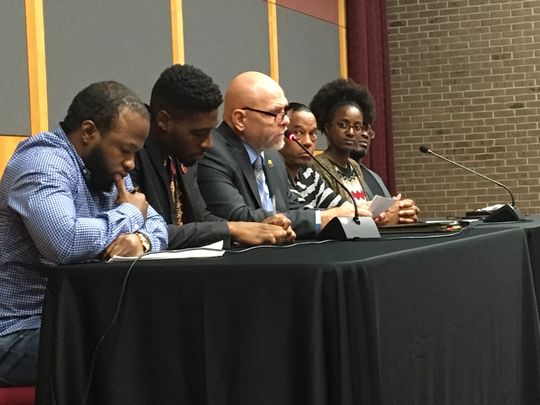
A voting restoration event at Rutgers, featuring many NJSTEP students, drew a large crowd this week, read full story here.
9/21/18 – “Rutgers program educates prison inmates while they serve time”… read full article
9/23/18 – EDITORIAL: “Prison program will improve many lives” … read full article

Thirty years. Eight months. Fourteen days. That’s how much time out of his 30-to-life sentence Ronald Pierce served in New Jersey’s maximum security prisons before being paroled.
After more than three decades of life spent on the “inside,” what’s a newly released person to do?
Well, for Pierce it would be business as usual. He would continue pursuit of his bachelor’s degree in justice studies from the School of Criminal Justice at Rutgers University–Newark (RU-N) thanks to the New Jersey Scholarship and Transformative Education in Prisons (NJ-STEP) program.
NJ-STEP, a statewide initiative administered by RU-N, works in partnership with the New Jersey Department of Corrections, the State Parole Board, and a network of public and private, two- and four-year colleges, including Rutgers University–New Brunswick and Rutgers University–Camden, to provide higher education courses to eligible individuals who are incarcerated in one of New Jersey’s seven correctional facilities. The program also assists in the transition to college life of released students who demonstrate college-readiness and an eagerness to improve their lives.
Pierce enrolled in NJ-STEP during the spring semester of 2013, and when he left East Jersey State Prison in 2016, he had earned an associate’s degree in liberal arts from Mercer County Community College and completed two RU-N courses toward his bachelor’s degree. Pierce was one of 150 students in NJ-STEP’s first cohort of adult male students, selected competitively out of a field of 1,100 eligible applicants. The fact that he already had 12 college credits under his belt before he enrolled made him a top contender for the program.
“NJ-STEP is a great program. We learned from prominent scholars,” Pierce stated. He recalled thought-provoking philosophy lectures by Cornel West, in-depth lessons on Latin American history by Chris Hedges, and lots of spirited discourse among his classmates.
“NJ-STEP kept us connected to the outside world and helped to create an atmosphere of change throughout the entire prison. There was a sense of community, collegiality, and cooperation. And most importantly, there was hope for a better future. Not just individually, but hope for an improved system and better policies that impacted everyone on the inside.”
According to Pierce, for these reasons and more, NJ-STEP became quite popular. “Everyone wanted to join. One of the eligibility requirements is a high school diploma or equivalent. So, quite a few people assertively sought tutoring to pass the GED exam.”
Soon after his release, Pierce transitioned to RU-N. He graduated summa cum laude in 2018 and became RU-N’s first graduate of the justice studies program.
Also in 2018, Pierce was named the inaugural Democracy and Justice Fellow at the New Jersey Institute for Social Justice (NJISJ) based in Newark, New Jersey. Pierce had interned at NJISJ during his last two semesters at RU-N.
The Democracy and Justice Fellowship is awarded to a previously incarcerated person who has demonstrated great compassion and advocacy for individuals in prison and those released. The two-year program provides gainful employment and networking opportunities for a talented and dedicated person who has a felony conviction.
“I’m so thankful for my internship with NJISJ because it confirmed that social justice activism is my calling. It’s a meaningful way for me to make a difference and to help my friends on the inside,” Pierce shared.
As a Democracy and Justice Fellow, Pierce hopes to tear down the many barriers to re-entry. While the lack of housing and employment present tremendous challenges for those newly released, Pierce believes restoration of voting rights is the greatest concern. A healthy democracy demands full, unfettered civic engagement, according to Pierce, who last casted a vote in 1985.
“Our voices matter. Through voting we’re no longer silenced. Voting empowers us and allows us to have a say in how we want to be governed.”
During the ensuing two years, Pierce looks forward to convincing state legislators likewise.

The Common Application announced Tuesday that it is dropping the question it has been asking since 2006 about applicants’ criminal histories. Read More
From: https://www.njspotlight.com
Former Gov. Jim McGreevey says initiative would be ‘a game changer,’ offering those who are incarcerated the prospect of a career rather than a return to the streets ‘with no hope’
New Jersey would become one of the few states in the nation to provide state financial aid to those who are incarcerated and want to take college courses under a measure working its way through the Legislature. By doing so, it would expand access to college course to more inmates, as existing programs rely on national foundation grants.
Advocates said that ensuring prisoners who want to take classes can afford to do so could be transformational in helping those serving time be able to change their lives and better themselves when they complete their sentences and return to society.
“This is tremendously important; it’s a game changer for many of our clients,” said former Gov. Jim McGreevey, who is chairman of the board of the New Jersey Reentry Corporation. “Taking these courses allows them to have a goal linked to long term career prospects, as opposed to returning to the streets with no hope other than the chaos of the streets.”
A 2014 RAND Corporation study found that those who took classes — college, vocational and high school-equivalency degree courses — while in prison had lower rates of reincarceration and higher rates of post-release employment than prisoners who did not take classes. The study also found that “the direct costs of reincarceration were far greater than the direct costs of providing correctional education” and “correctional education programs appear to far exceed the break-even point in reducing the risk of reincarceration.”
The bill (S-2055) would eliminate a provision in current state law that prohibits prisoners from receiving either state grants or scholarships. Instead, anyone who was a New Jersey resident for at least a year before incarceration would be eligible for aid, subject to the same rules that apply to all other grant recipients, if the state Department of Corrections (DOC) deems him or her eligible to enroll in college classes.
“New Jersey has made significant strides in reducing its prison population through the offering of higher education opportunities,” Cunningham said. “However, if New Jersey loses the ability to keep programs such as NJ-STEP at its facilities, it will see its inmate population increase and raise the state’s expenses.”
Ruth Delaney, program manager at the Vera Institute of Justice, which has provided funding for NJ-STEP, praised the bill’s passage.
“New Jersey has long been a leader in providing postsecondary education for people in prison, but the Senate vote today moved the state one step closer to removing one of the biggest obstacles to enrollment,” she said. “Expanding access to postsecondary education in prison will help provide people with the skills they need to secure jobs and other opportunities upon release … Our hope is that with states like New Jersey paving the way, others will follow suit and reconsider state and federal barriers to postsecondary education in prison, so as to create a justice system that produces better outcomes for all.”
The bill cleared the Senate last week by a vote of 27-10, largely along party lines. It now heads to the Assembly for consideration.
From: https://www.educationdive.com
When Congress decided to stop extending Pell grant eligibility to prisoners, despite the fact that a Government Accountability Office report at the time showed there was no impact on other needy students’ ability to receive aid by maintaining prison Pell, several institutions in many states worked privately to continue to extend these opportunities to students in their states.
Rutgers University, New Jersey’s public system that includes 30 campuses, and Raritan Valley Community College, in Branchburg Township, were among them, and are the only two institutions in the state approved.
Even before President Obama announced a pilot program to bring back prison Pell beginning in the 2016-17 school year — with Rutgers and Raritan Valley co-authorized as a pilot site serving seven correctional facilities across the state — the institutions had been working to provide educational associations to incarcerated individuals, with particular efforts toward reintegrating them back onto the campuses upon their release.
Obama’s Second Chance Pell program was enacted as an executive action under the experimental sites provision of the Higher Education Act in 2015, targeting approximately 12,000 inmates at over 100 federal and state penal institutions across the country who are within three and five years of release. The partnering institutions offer classroom-based instruction at the prisons — in the case of Rutgers and Raritan Valley, New Jersey inmates can earn either an associate of arts degree for transfer, or a bachelor of arts in criminal justice. Raritan Valley offers the associate degree, Rutgers the bachelors, and the entire program is administered under the umbrella of the NJ-Step program, which is the latest iteration of a consortium agreement around prison education in New Jersey. NJ-Step is housed at Rutgers and serves as a liaison organization between the community college, university system and the prison system.


Chris Hedges recently published a piece about teaching Victor Hugo’s Les Miserables with NJ-STEP. Read full article here
From: https://www.truthdig.com
NEWARK, N.J.—This is the story of Emmanuel Mervilus, who got locked up for a crime he did not commit, whose life was derailed and nearly destroyed by the experience and who will graduate this spring from Rutgers University. It is a story of being a poor black man in America, with the exception being that most poor black men never get a second chance.
The only reason Mervilus got a second chance was because of one man, history professor Don Roden, who founded the Mountainview Program at Rutgers for formerly incarcerated students. This program accepts, among others, the students I teach in prison, one of whom, Ron Pierce, also will graduate this spring.
There are only a few saints in this world. Professor Roden is one.
Written by Chris Hedges.

Emmanuel Mervilus, who will graduate soon from Rutgers after being in prison, speaks in Newark, N.J., at an event sponsored by the Mountainview Program, which fosters education among those who have been incarcerated. (Mountainview Program)
Read the full story here

A recent piece from the American Education Council’s Higher Education Today:
Policy Levers Leading the Way to Reentry for Incarcerated Students.


From: https://rutgersclassics.com/
Here’s another great Rutgers Classics first. Honored in the inaugural group of seven recipients of Rutgers New Brunswick’s important new faculty award—the Chancellor’s Award for Excellence—is Associate Professor in Classics Emily Allen-Hornblower.
In a ceremony Tuesday 4 October 2016, Chancellor Richard L. Edwards recognized Professor Allen-Hornblower in the category of Excellence in Service.
In presenting the award, Edwards cited “her heartfelt conviction that the Classics are of significance to people in all life situations and her dedication to bringing her scholarship beyond the university classroom to new audiences through her participation in the New Jersey Scholarship and Transformative Education in Prisons program (NJ-STEP)”.
Emily Allen-Hornblower has taken her teaching talents outside Rutgers’ classrooms, in an unusually visceral way. In November 2014 she spotted a feature in Rutgers Today about an ex-inmate and university student, Christopher Etienne, who managed to receive his undergraduate degree in large part through the help of Rutgers’ innovative Mountainview Program. It was then that Emily was inspired by the idea of being able to teach currently incarcerated inmates.
This led to her involvement with NJ-STEP, an association of colleges and universities that provide college courses for inmates and assist in their transition to college life upon release from prison.
“Maximum-security inmates at a New Jersey prison have been learning about the literary world with Rutgers University associate professor Emily Allen-Hornblower. But the novelty isn’t that they are studying literature, or even that they are doing it behind bars. ” Read More
A recent Rutgers Magazine feature shares details on a recent visit from President Barack Obama, including a roundtable discussion he hosted featuring participants from NJ STEP.

“I’ve spoken to men and women who are part of programs like NJ-STEP here at Rutgers-Newark. You’re giving prisoners a chance to start taking college courses before their release so that they can re-enter society with marketable skills.”
FULL REMARKS BY THE PRESIDENT ON CRIMINAL JUSTICE REFORM AT RUTGERS UNIVERSITY NEWARK